
Selective Outrage: April Verlato’s Attack on Michael Cao Reveals a Troubling Double Standard
Opinion and Investigative Analysis
By Arcadia’s Best News Editorial Board
August 9, 2026
Former Arcadia Councilmember April Verlato has once again inserted herself into an approaching city election, this time through an email blast attempting to connect Councilmember Michael Cao to a recent federal investigation involving EDI Media and its founder, James Su.
The email is presented as a public accountability report, but its structure more closely resembles election season opposition messaging. It uses a federal investigation involving other individuals, combines it with photographs of Cao at a public event and then invites readers to suspect wrongdoing that the email never establishes.
Verlato ultimately asks whether it is time to demand Cao’s resignation.
That is not a minor suggestion. Calling for an elected official to resign requires evidence of misconduct, serious dereliction of duty or conduct demonstrating that the official is no longer fit to serve.
Verlato’s email presents none of those things.
It does not show that Cao acted on behalf of a foreign government. It does not show that he received prohibited assistance. It does not show that he knew about any potentially unlawful activity involving EDI Media. It does not show that he was searched, subpoenaed, charged or identified as a subject or target of a federal investigation.
Instead, the email asks readers to bridge the evidentiary gap through suspicion.
That is not an investigation. It is guilt by association.
Verlato transforms an investigation involving others into an attack on Cao
Federal agents recently searched several Southern California properties, including EDI Media’s West Covina office and Su’s residence. The searches were reportedly connected to broader investigations concerning possible foreign influence.
Those searches are a legitimate matter of public interest. Any evidence of unlawful foreign influence should be thoroughly investigated, regardless of the political affiliation or ethnicity of the people involved.
But a search warrant is not a criminal charge, a conviction or a finding of wrongdoing. Public reporting has also made clear that it remains uncertain whether every person or organization whose property was searched was a target of the investigation.
Cao is not identified in the public reporting cited by Verlato as a target, subject or participant. Verlato’s email nevertheless places his photograph immediately beside material concerning the FBI searches and then asks whether he should resign.
The effect is unmistakable. It encourages readers to mentally place Cao inside a federal investigation without presenting evidence that he is actually connected to it.
If Verlato possesses evidence that Cao participated in improper conduct, she should publish it. If she does not, attaching his name and photograph to an unrelated investigation is irresponsible.
Public figures are entitled to criticize one another. They are not entitled to manufacture implications and then avoid responsibility by placing a question mark at the end.
A disclosed vendor relationship is recast as evidence of divided loyalty
Verlato points to Cao’s campaign’s use of EDI Media as a media vendor during the 2022 election. That relationship is a legitimate subject for public inquiry.
But the transaction was identified in campaign records. Verlato does not allege that Cao concealed the vendor, falsified a disclosure or received an unreported benefit.
Her email instead attempts to transform the identity of the vendor into evidence of a broader foreign relationship.
That conclusion does not follow from the facts presented.
Media companies routinely provide services to candidates, businesses, nonprofit organizations and public agencies. Purchasing media services does not make a customer responsible for every separate activity, client or business relationship involving the vendor.
Federal Foreign Agents Registration Act records concerning EDI Media may justify questions about the company’s disclosed work for a foreign principal. They do not automatically establish that every unrelated commercial customer also acted for that foreign principal.
Verlato provides no evidence that a foreign government requested, directed, approved, funded or influenced Cao’s campaign activity. She identifies no communication between Cao and a foreign official. She presents no evidence that EDI Media’s work for Cao was subsidized by anyone other than his campaign.
The email uses the existence of a FARA registration as an instrument of suspicion while failing to establish its relevance to Cao’s campaign.
That is a significant omission.
Verlato’s own photograph reveals the flaw in her argument
Verlato’s theory depends heavily on photographs. Cao appeared at an event with Su, so the photograph is presented as proof of a meaningful and suspicious connection.
But another photograph, omitted from Verlato’s email, reveals the double standard at the center of her argument.

(Then Arcadia Councilmember April Verlato, right, stands alongside then Councilmember Eileen Wang as Zhang Ping, then China’s consul general in Los Angeles, holds a City of Arcadia certificate during his farewell reception on December 14, 2022)

(Then Arcadia Councilmember April Verlato, right, stands alongside then Councilmember Eileen Wang as Zhang Ping, then China’s consul general in Los Angeles during his farewell reception on December 14, 2022)
The photograph shows Verlato standing beside then Councilmember Eileen Wang while Zhang Ping, then China’s consul general in Los Angeles, holds a City of Arcadia certificate of recognition.
There is no evidence that Verlato committed wrongdoing by attending the event. Elected officials often attend diplomatic and cultural receptions, present ceremonial certificates and take photographs with foreign representatives.
The photograph matters because it exposes the inconsistency in Verlato’s current argument.
If standing beside a person with connections to the Chinese government is enough to question an official’s integrity, what conclusion does Verlato expect residents to draw from her own photograph with China’s senior diplomatic representative in Los Angeles?
If presenting city recognition to Zhang was legitimate public service when Verlato participated, why does Cao’s presence at a Chinese American media event become evidence of questionable loyalty?
Verlato cannot reasonably have it both ways.
Either photographs and ceremonial contact are evidence of foreign allegiance, in which case she must explain her own conduct under the same standard, or such photographs merely document normal public engagement, in which case she should stop using them to insinuate wrongdoing by political opponents.
The fair conclusion is that neither photograph proves improper conduct. Verlato’s selective use of one photograph while omitting the other demonstrates why her email should be viewed as political advocacy rather than an objective investigation.
Verlato Also Presented a City Certificate at an EDI Event
A separate photograph provides an even more direct comparison to the conduct Verlato now criticizes. The image shows Verlato attending an EDI Media event and presenting a City of Arcadia certificate on behalf of the city.
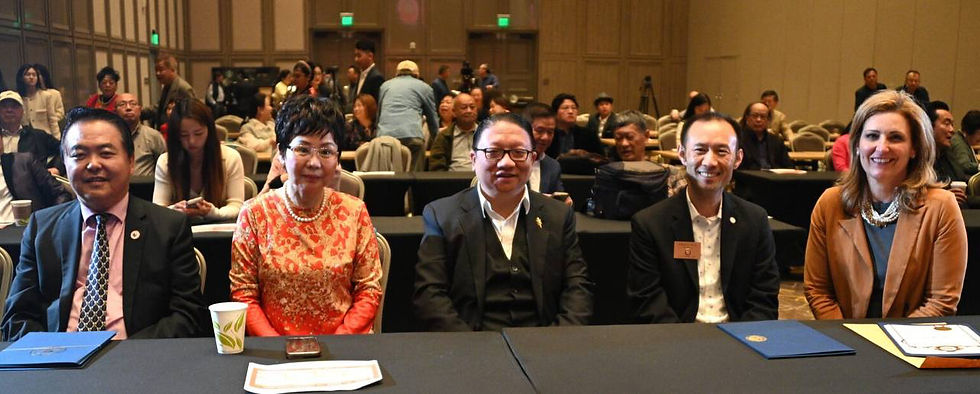
(Former Arcadia Mayor April Verlato attends an EDI Media event and presents a City of Arcadia certificate on behalf of the city)
This was not simply a photograph taken while Verlato happened to be present. By presenting an official City of Arcadia certificate, she was participating in the event in her capacity as a city representative.
City certificates do not ordinarily appear without advance preparation. A request must generally be submitted, the recipient and occasion identified, and city staff time used to prepare the document.
If Verlato personally requested the certificate, as city records may confirm, the contradiction would be direct. She would have affirmatively asked city staff to prepare official recognition for an EDI event and then appeared at that event to present it on the city’s behalf. She is now attacking Cao for attending an EDI event and questioning why councilmembers were present in any representative capacity.
That is substantially similar to the conduct she now portrays as suspicious.
Verlato cannot credibly condemn another councilmember for appearing at an EDI event on behalf of Arcadia while omitting the fact that she herself attended an EDI event and presented an official city certificate. Her own participation involved more than mere attendance. The presentation of a city certificate indicates planned and official engagement with the organization.
Before suggesting that Cao’s attendance demonstrated a questionable connection, Verlato should have disclosed her own relationship with EDI Media and explained why she believed her official participation was appropriate while his attendance was not.
Her failure to provide that context is material. It allowed her to present normal civic engagement as suspicious when Cao participated, while concealing comparable conduct involving herself.
If the records establish that Verlato initiated the request, her criticism of Cao would not merely appear inconsistent. It would demonstrate that she is attacking another official for the same type of city engagement she personally arranged and publicly performed.
The issue is not that Verlato attended an EDI event or presented a certificate. Such ceremonial recognition is a routine part of municipal public service. The issue is that she now attempts to portray similar engagement by a political opponent as evidence of compromised integrity while leaving her own conduct entirely out of the story.
That is the very definition of a double standard.
Verlato’s EDI Media history is conspicuously absent
Verlato has also appeared in EDI Media coverage and reportedly participated in interviews involving the same organization she now portrays as inherently disqualifying.
There is nothing improper about an Arcadia official speaking with Chinese language or Chinese American media. Arcadia has a large Asian American population, and public officials have a responsibility to communicate with residents through a wide range of media outlets.
Yet Verlato’s own appearances are directly relevant to the standard she now seeks to impose on Cao.
If being interviewed by EDI Media creates a suspicious connection, then Verlato should explain her own interviews. If her appearances were legitimate media engagement, then she should acknowledge that appearing in EDI coverage does not establish a compromising relationship.
Instead, her email excludes her own history while highlighting Cao’s.
That is not a minor oversight. It is a material omission that allows Verlato to create a political narrative she could not sustain if the complete record were presented.
A credible investigation examines facts that support and undermine its premise. A political attack selects only the facts useful to its desired conclusion.
Verlato’s email does the latter.
Her lack of an invitation proves nothing
Verlato emphasizes that she was not invited to an event attended by Cao and that the event did not appear on the council’s public calendar.
Neither fact establishes misconduct.
Verlato’s lack of an invitation may explain her personal dissatisfaction, but it has no apparent legal or ethical significance.
Public officials do not receive identical invitations, and one councilmember’s exclusion does not make another councilmember’s attendance improper.
The absence of an event from a public calendar is equally inconclusive. Verlato does not identify a law or city policy requiring the event to be listed. She does not establish that Cao attended in an official capacity, used city funds, accepted a reportable gift or spoke on behalf of the city.
By emphasizing that she was not invited, Verlato inadvertently makes the email appear more personal, not more investigative.
Residents are left to ask whether this controversy is genuinely about government transparency or whether an old political grievance has been repackaged as a public integrity investigation.
A continuing campaign against councilmembers who refuse to align with her
Verlato left the City Council in December 2024, but she has continued to play an aggressive role in Arcadia politics through frequent email campaigns, public accusations and support for political actions aimed at members of the current council majority.
Her principal targets have repeatedly included Cao, Cheng and David Fu, Asian American councilmembers who have not aligned with her political agenda.
Criticism of Asian American officials is not automatically racial. No official should be protected from legitimate scrutiny because of ethnicity.
But a recurring pattern becomes relevant when ordinary contact with Chinese American organizations is selectively portrayed as evidence of foreign influence. The pattern becomes even more concerning when Verlato excuses or omits comparable conduct involving herself and political allies.
Her communications frequently present political disagreement as evidence of corruption, retaliation, concealment or improper loyalty. Officials who oppose her preferred position are not merely described as wrong. They are portrayed as ethically compromised or unworthy of office.
That approach transforms public debate into a continuing campaign of personal destruction.
Residents should ask why Verlato appears so determined to discredit the Asian American councilmembers who do not accept her political leadership. They should also ask whether her current email is intended to inform the public or weaken Cao before the November election.
The timing, selective presentation and demand for resignation strongly suggest that electoral politics are inseparable from the message.
Verlato Is Not Merely a Former Official Commenting From the Sidelines
One highly relevant fact is absent from Verlato’s email. She is currently a candidate for the United States House of Representatives in California’s 28th Congressional District and is running against incumbent Representative Judy Chu in the November 3, 2026 general election.
Her candidacy is confirmed by Federal Election Commission records under the committee name Verlato for Congress.
That changes the context in which her email should be evaluated. Verlato is not simply a former councilmember offering detached commentary about city government. She is an active federal candidate seeking votes, financial support, media attention and greater political visibility.
Her decision to frame a local Asian American councilmember’s media contacts as evidence of possible Chinese government influence may appeal to a broader campaign narrative she could use in her congressional race. It also places her name at the center of a highly charged controversy involving China, foreign influence and public integrity.
This does not prove that the email was produced or distributed by her congressional campaign. It does, however, create an obvious political interest that should have been disclosed to readers.
Was the email intended solely to inform Arcadia residents, or was it also designed to strengthen Verlato’s congressional campaign by elevating her profile as a critic of alleged Chinese influence?
Did Verlato for Congress pay for, assist with or benefit from the research, preparation or distribution of the communication?
Was the content discussed with campaign staff, consultants, donors or political organizations supporting her congressional candidacy?
Is Verlato using allegations against Cao, Cheng and Fu to build a political narrative that benefits her campaign against Judy Chu?
Those questions are particularly important because Verlato’s email portrays itself as a public service announcement rather than campaign advocacy. Readers are entitled to know when a person presenting an investigation also has an active political campaign that may benefit from its timing and subject matter.
The omission reinforces concerns that the communication is not simply about accountability at Arcadia City Hall. It may also serve Verlato’s effort to remain politically relevant, attract attention to her congressional candidacy and position herself within a larger national debate over China.
Verlato should disclose whether any campaign resources were used and whether the communication was coordinated with her congressional campaign. Even if no campaign funds were involved, she should acknowledge that she is a current federal candidate who may receive political benefit from the controversy she is promoting.
Transparency cannot be selectively demanded from others while withheld when it concerns Verlato’s own political interests.
Verlato demands transparency while withholding relevant context
Verlato frequently invokes transparency and accountability. Those principles must apply to the person making the accusation as well as the person being accused.
A transparent account would have disclosed Verlato’s own appearances in EDI Media coverage. It would have included the photograph of her standing with Zhang Ping. It would have explained why her contact with Chinese officials and Chinese American media should be evaluated differently from Cao’s contact.
A transparent communication would also disclose who paid for the email, how widely it was distributed and whether its preparation or timing involved Cao’s political opponents.
Verlato provides none of that context.
Instead, she asks residents to judge Cao under a standard she does not apply to herself.
That is not accountability. It is selective outrage.
The election context raises campaign reporting questions
Cao is expected to appear on the November ballot. Verlato’s email directly attacks his integrity and fitness for office while suggesting that he should resign.
California campaign rules may apply when money is spent on communications advocating the election or defeat of an identified candidate. Whether Verlato’s email qualifies as a reportable expenditure depends on several facts, including its timing, content, cost, distribution, funding and any coordination with a candidate or committee.
The email does not automatically constitute a violation. Only the appropriate filing authority or the California Fair Political Practices Commission could reach that determination after reviewing the complete facts.
Still, Verlato should voluntarily disclose who financed the communication and whether she coordinated with Cao’s opponent or any political organization.
Someone demanding complete transparency from current officials should not resist transparency concerning her own election season political activity.
If the blast is independent civic commentary, Verlato can say so and identify its funding. If it is part of an organized effort to influence Cao’s reelection contest, Arcadia voters deserve to know who is involved.
Personal political warfare carries a public cost
There is no evidence in the email itself that Verlato used city employees, equipment or accounts to produce it. A direct allegation that she misused public resources would therefore require additional proof.
However, Verlato’s continuing political campaigns can still create costs for the city when staff members must research allegations, respond to extensive requests, prepare public reports, seek legal advice or devote council time to controversies unsupported by evidence.
The public has a right to request records and criticize its government. That right should be protected.
At the same time, public accountability should not become a pretext for repeatedly forcing taxpayers to finance the administrative consequences of one former official’s ongoing conflicts with former colleagues.
The city should disclose the staff time and legal expenses generated by repeated demands for investigations or council action. Residents can then decide whether these campaigns serve a legitimate public purpose or primarily prolong personal political disputes.
Asian American civic participation must not be treated as suspicious
The most troubling feature of Verlato’s email is the way it uses contact with Chinese American media and community figures to raise questions about an Asian American official’s loyalty.
Foreign influence should be investigated through financial records, communications, official actions and evidence of direction or control. It should not be inferred from ethnicity, attendance at cultural events or participation in ethnic media.
Asian American officials should not face a presumption of divided loyalty simply because they communicate with Chinese speaking residents or appear at Chinese American events.
Verlato’s own history demonstrates the unfairness of that standard. She attended a farewell reception for China’s consul general and stood beside him as he held a city certificate. She also appeared in EDI Media coverage.
Those activities do not make Verlato disloyal. They do, however, expose the double standard she now applies to Cao.
Arcadia should reject any political tactic that treats ordinary Asian American civic engagement as inherently suspicious while identical conduct by a non Asian official is accepted as routine.
Holding elected officials accountable is essential. Turning Asian identity and community association into political evidence is not accountability.
Arcadia deserves better than politics by insinuation
Verlato is entitled to oppose Cao. She is entitled to support his opponent and criticize his decisions. She is entitled to argue that Arcadia should choose different leadership.
What she should not do is use an unrelated federal investigation to imply misconduct she cannot establish, omit her own comparable interactions and then demand that residents question the integrity of an Asian American official through guilt by association.
The facts presented do not show that Cao acted for a foreign government. They do not show that he participated in criminal activity. They do not show that his campaign’s media relationship was connected to EDI Media’s work for a foreign principal.
What the record does show is a striking inconsistency in Verlato’s standards.
Her interactions with Chinese officials are treated as civic engagement. Her appearances in EDI Media are treated as ordinary interviews. But when Cao engages with the same community, she portrays it as a threat to public trust.
That double standard should concern every Arcadia resident, regardless of political affiliation.
With an election approaching, voters should carefully examine not only the people being accused but also the people making the accusations. They should ask what facts were included, what facts were withheld and who benefits from the narrative being circulated.
Accountability requires evidence, consistency and honesty.
Selective outrage is not accountability. Personal political warfare is not investigative reporting. A photograph is not proof of disloyalty, and Asian American civic participation is not evidence of foreign control.
Arcadia residents deserve the complete record. They deserve fair standards applied equally to every official. Above all, they deserve facts rather than another political narrative designed to turn suspicion into votes.




Comments