
Court quashes lawsuit challenging Arcadia council censure
• ARCADIA WEEKLY
Court quashes lawsuit challenging Arcadia council censure
byJoe Taglieri
July 24, 2026
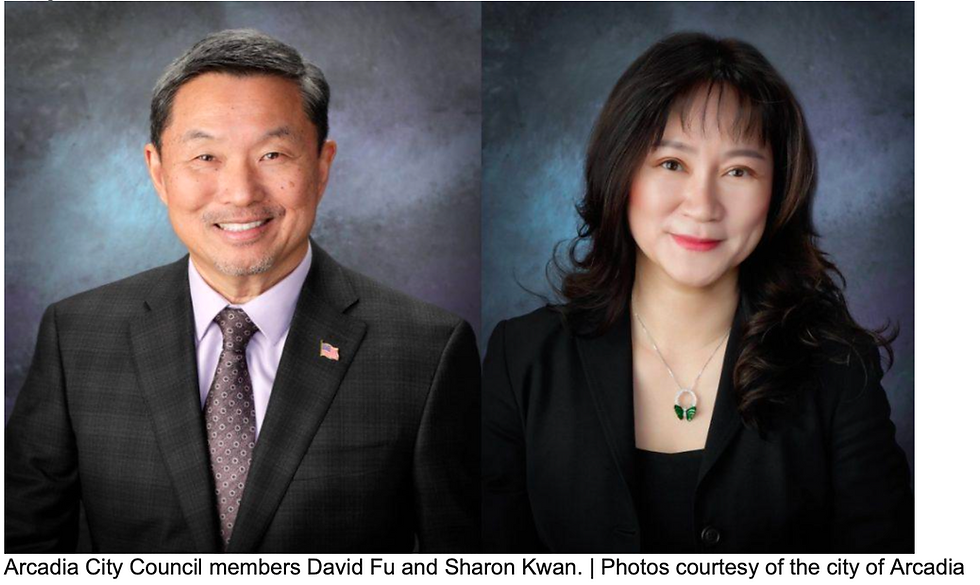
A Los Angeles Superior Court judge Thursday dismissed a lawsuit challenging the
Arcadia City Council’s censure of then-Mayor and current Councilwoman Sharon Kwan.
The council voted 4-1 in September to censure Kwan for alleged offenses that included
violating rules of decorum during meetings and “engaging in un-collegial behavior,
unprofessional temperament, and unfounded accusations against Councilmembers simply
because other Councilmembers expressed a differing viewpoint,” according to the censure
resolution.
Kwan has said the censure was an attempt by the council majority — current Mayor Paul
Cheng, Mayor Pro Tem David Fu and Councilman Michael Cao — to quell her opposition
to large pay increases for city employees and discredit her allegations of sexual
harassment and gender discrimination against Fu.
In March an investigation into the harassment allegations determined Kwan’s charges
were unsubstantiated. According to Kwan that conclusion “is not accurate, and I do not
believe it was fair” because the only people interviewed were the four other council
members, Fu’s wife and City Manager Dominic Lazzaretto.
Ex-Mayor and Councilwoman Eileen Wang — who resigned earlier this year after federal
prosecutors outed her as an intelligence operative for the People’s Republic of China —
cast one of the votes to censure Kwan.In his ruling Thursday, Judge Thomas D. Long found that the censure was
a constitutionally protected exercise of free speech and did not violate the Ralph M. Brown
Act, which governs how local governments in California operate. The ruling granted the
city’s motion to dismiss the lawsuit.
Cory Briggs, attorney for plaintiffs Stephanie Aiken and Laurie Thompson, did not
immediately respond to a request for comment.
Previously he said they sued “because the censure was punitive and retaliatory, contrary
to federal and state law.
“The plaintiffs are residents and taxpayers in Arcadia and believe that the council
majority’s illegal actions are impeding Mayor Kwan’s ability to best serve their interests,”
Briggs said after the lawsuit’s Sept. 18 filing.
According to the lawsuit, “The ringleader behind (the censure) was Councilmember David
Fu, against whom Mayor Kwan had submitted an administrative sexual-harassment
complaint … at least one month earlier. Shortly thereafter the City Manager informed at
least three members of (the City Council), including Councilmember Fu, that the complaint
had been filed and that city would hire an outside investigator to investigate the complaint.
At the time (the censure resolution) was adopted, the investigation of Mayor Kwan’s
complaint had not been completed and she had not even been interviewed by the outside
investigator.”
The suit alleged the council “knew the conclusion about ‘unfounded accusations of
sexism’ to be false, or at least strongly suspected it to be unsupported by sufficient
evidence, when made.”
Plaintiffs also claimed the censure action, which was the first of its kind in Arcadia history,
has had a “chilling effect” that “has penalized Mayor Sharon Kwan and/or otherwise
discouraged her from expressing herself.”
The judge, however, agreed with the city’s argument that officials did not violate the
Brown Act when they voted for censure.
A censure is a formal statement of disapproval adopted by a legislative body in
response to a member’s conduct.
“The censure of then-Mayor Kwan consisted solely of an official expression of disapproval
and did not impose additional penalties or restrictions,” according to a statement from the
city.The court concluded that the council’s censure of Kwan was an act of constitutionally
protected speech under the First Amendment and cited a lack of evidence that the
censure was the culmination of “retaliatory actions.” The judge also noted that the District
2 councilwoman remained able to express opinions as a council member.
“The court further determined that the plaintiffs failed to establish that the censure violated
the Brown Act, clarifying that a dispute between two councilmembers, or criticism of
a public official, does not by itself give rise to a Brown Act claim,” city officials said.
“Importantly, the court also concluded that Arcadia’ District 2 residents were not
disenfranchised by the censure action.”
Attorneys for the city argued for the court to apply California’s anti-SLAPP, or Strategic
Lawsuit Against Public Participation law designed to preserve constitutionally protected
speech from lawsuits.
Officials said the lawsuit defense cost the city $65,000.
Ex-Mayor Wang pleaded guilty earlier this year to federal charges of secretly acting as an
agent of a foreign government, a felony with a maximum prison sentence of 10 years. Her
sentencing was scheduled for Oct. 6.
Wang and her ex-fiance Yaoning Sun, who was her campaign treasurer in 2022 and is
currently serving a four-year sentence for a similar crime, worked for a news website that
published propaganda at the direction of PRC military officials, according to the U.S.
Department of Justice.
The council appointed John Han, a self-employed investment manager, to serve the
remainder of Wang’s term that was up for reelection in November.


Comments